Nutex Update: Revenue at Risk as Lawmakers Propose Reforms and Stakeholders Press for IDR Overhaul
IDR reforms would likely result in a significant drop in revenue, shifting investor focus to long-term prospects, governance issues, and allegations of wrongdoing.
Initial Disclosure: Affiliates of Capybara Research take market positions in the companies we report on and our investigative journalism is funded by the trading profits of these affiliates. This report is not financial advice. Do your own due diligence. Please read our full disclaimer at the bottom of this report.
If you have information that you'd like to share, we encourage you to contact us.
We protect our sources, and anonymize identities where necessary.
As investigative journalists, we have an ethical duty to protect the identities of our sources, particularly when a source is at risk of harm or retaliation. To that end, we anonymize sources where necessary. This may include using partial names, aliases, generic job titles, or broad identifiers such as "former executive", "former insider", or "industry expert".
In our previous report on Nutex Health, we highlighted that receivables were artificially inflated by IDR awards that were ineligible for arbitration. Two months after we published, Nutex took a $55 million charge for arbitration claims that it determined were ineligible for reimbursement. The stock declined over 20% on the news.
We believe that IDR reform is coming and investors should be prepared for a large reduction in Nutex’s revenue.
Key Findings
On October 8, Energy and Commerce Committee Ranking Member Frank Pallone, Jr. (D-NJ) introduced a bill to reform the No Surprises Act and “rein in bad actors.” The bill would end IDR after 2027, replace baseball-style arbitration with the qualifying payment amount (QPA) as the out-of-network rate, require payment within 30 days, and mandate audits of claims data.
The proposal carries weight: Pallone is the Ranking Member on the strategically important committee and he was the lead House sponsor of the original No Surprises Act, which established IDR and the loopholes currently being exploited.
A broad coalition is calling for IDR reform, citing systematic gaming, excessive awards, and rising health care costs. Supporters include:
- Employer, Consumer, and Labor Groups:
- Policy Institutes:
Federal courts recently dismissed payers’ challenges to IDR awards, finding no judicial mechanism to review them. The No Surprises Act bars judicial challenges, leaving only Congress with the authority to fix or replace the law.
We estimate that IDR reform could reduce Nutex’s revenue by approximately 50-57%. That range is based on the change in Nutex’s revenue per visit after it started submitting IDR disputes. Prior to then, revenue per visit was $1,500-$1,700 and post IDR it increased to $4,000-$4,200 per visit. We estimate that with IDR reform, revenue per visit would adjust to $1,800-$2,000 per visit. This assumes a return to market rates with a 20% premium over previous revenue per visit due to changes in product mix including more in-patient services.
Analysis of publicly available IDR data suggests that IDR reform could reduce Nutex’s revenue by 45%-55%. The estimate reflects the company’s disclosure that “nearly 60%” of bills go to arbitration, 85% of arbitration cases are won, 80% of awards are collected, and the average award value is 8.5 to 10 times the QPA. This estimate requires many assumptions, so we consider estimating revenue per visit a more reliable approach.
IDR awards have dominated Nutex’s results and investor attention. If revenue declines, investors are likely to focus more on the company’s long-term prospects and governance. As we have previously reported, current and former partners have made allegations of fraud and other wrongdoing against the company’s founder and CEO. Partners have also alleged that accounting arrangements shifted earnings from related entities and inflated results. Reduced IDR revenue could bring these concerns into sharper focus.
There have been additional developments since we last reported on Nutex, including:
- In June, STATnews published an investigation reporting that the company was turning away emergency-room patients based on their inability to pay, including a patient with “telltale signs of a heart attack.”
- In September, Nutex suffered a major data breach that exposed internal documents, including patients’ financial and health information. We analyzed the data, which is now freely available on the dark web, and confirmed it contained financial and health information for many patients.
Nutex’s Revenue is Heavily Reliant on Outsized IDR Awards
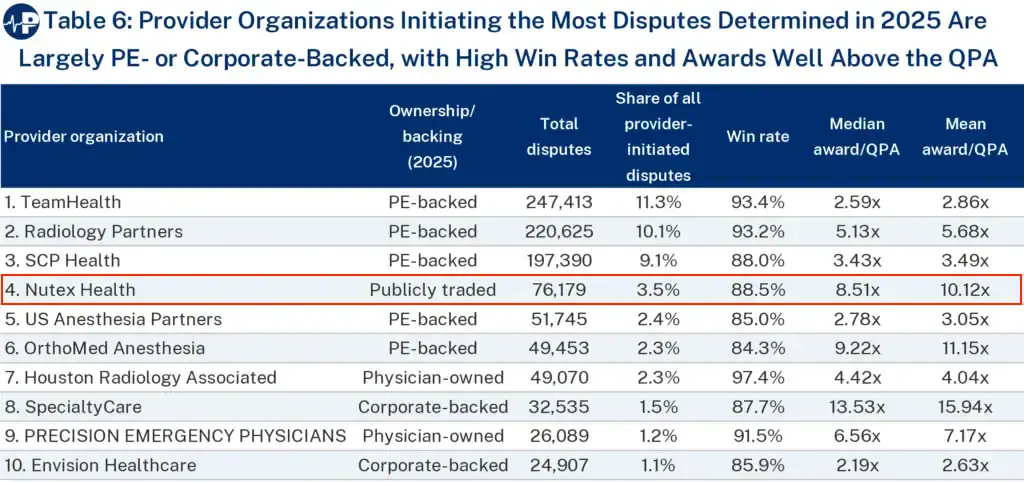
Nutex’s reliance on IDR revenue is evident in the publicly available IDR data. In 2025, the most recent period available, Nutex was the fourth-largest filer of IDR disputes.
 source: Paragon Institute
It also shows that Nutex won 88.5% of its disputes and was awarded 8.5x to 10.1x the Qualified Payment Amount (QPA) on average. These figures highlight Nutex’s reliance on IDR revenue and its vulnerability to potential reforms.
Partners have made serious allegations against Nutex, and its corporate structure presents conflicts of interest. In our view, the company’s reliance on IDR to drive growth masks weakness in the underlying business. Before it began exploiting IDR, Nutex was closing facilities and struggling to stay afloat; its stock had fallen 90% after going public through a reverse merger. By 2025, Nutex was the fourth-largest filer of IDR disputes and a majority of revenue came from IDR awards.
IDR Reform is Coming and is Likely in the Next 14 Months
While it’s common knowledge that Nutex relies heavily on IDR awards, the market is less aware of efforts currently underway to reform IDR and rein in abuse. Employers, policy groups, and other stakeholders increasingly argue that the system needs changes to curb excessive awards and abuse, and lawmakers have submitted bills to address these issues. In our review, we found no groups speaking out in support of the current system, apart from the small number of entities benefiting from its exploitation. This lack of support highlights the growing consensus for reform.
Nutex investors should be prepared for IDR reform and the impact it will have on the company.
Recent activity in the House and Senate suggests reform could come within the next 14 months. If Nutex’s IDR revenue fell to market rates, we estimate total revenue would decline by about 50-57%. This estimate assumes that revenue per visit will revert to historical levels plus a 20% premium to account for changes in product mix and other factors.
Background
Until 2024, Nutex was struggling to stay afloat. One of its largest facilities had gone bankrupt, and physician partners had accused its founder and CEO of fraud. Two years after going public through a reverse merger, the company’s stock had fallen more than 90%.
Over the next two years, the stock rose 4,000%, from $5 to $200. The rally did not follow a new product, business line, or strategic initiative. Instead, it coincided with Nutex’s use of IDR, a process established by the No Surprises Act (NSA). The law, which took effect on January 1, 2022, was designed to protect consumers from surprise medical bills.
The NSA was designed to protect consumers from excessive out-of-network medical bills. Nutex operates out-of-network freestanding ERs, exactly the type of facility the law was intended to protect consumers from. Unsurprisingly, Nutex has faced criticism for predatory pricing, including charging $4,000 for a drive-through COVID-19 test.
Two years after the NSA took effect, some firms began using IDR to seek higher payments from insurers. Insurers may be unsympathetic targets, but ultimately, the costs are passed on to policyholders through higher premiums.
To combat alleged IDR abuse, payors resorted to filing lawsuits in federal court. They challenged the validity of IDR awards, arguing that the process was being systematically abused and sought relief from the courts. However, the NSA doesn’t allow for judicial review of IDR awards, leading the courts to dismiss the lawsuits. This leaves one primary avenue for addressing concerns about abuse: legislative reform. Congress needs to amend the law and reform or eliminate IDR.
Without Inflated IDR Revenue, Focus Shifts to Nutex’s Problems
For the past two years, Nutex’s revenue from IDR awards has overshadowed issues of governance, conflicts of interest, and allegations of wrongdoing. If IDR reform passes, earnings will revert to industry norms, prompting investors to focus more on the company’s long-term prospects rather than recent growth.
We’ve published two reports on Nutex’s business practices and the risks associated with the company. We encourage readers to review both reports to understand the full scope of Nutex’s business practices and the risks associated with the company.
Our first report focused on allegations of fraud, embezzlement, and self-dealing against Nutex’s CEO and chairman, Thomas Vo.
Our second report highlighted that revenue was inflated due to IDR awards for services that weren’t actually eligible for arbitration. In February 2026, two months after we published, Nutex took a $55 million charge for arbitration claims that it determined were ineligible for reimbursement. The stock declined sharply on the news.
More than a dozen Nutex partners, including physicians, medical directors, and board members, have accused the company and its CEO and chairman, Thomas Vo, of fraud, embezzlement, and self-dealing. Former insiders and other sources have corroborated the allegations, which describe a pattern of misconduct spanning more than a decade.
The allegations fall into three broad categories:
Partners allege Vo used his position to direct business to companies he secretly owned or controlled.
Partners allege Nutex diverted millions of dollars from physicians and partner emergency rooms.
They allege Vo used those funds to invest in other medical facilities that became part of Nutex.
Legal Disclaimer
Affiliates of Capybara Research are short shares of Nutex Health Inc (NASDAQ: NUTX)
Our research reports are for informational purposes and express our opinions, formulated from publicly available information, field research, and our work as investigative journalists. We firmly believe that publishing our research and opinions is in the public interest and is protected speech. We are entitled to our opinions and to express and share our opinions in a public forum.
Capybara Research is not a registered investment advisor. By accessing our reports, you acknowledge that you are responsible for your investment decisions and you bear full responsibility to do your own independent research and due diligence. This website and its contents are not to be construed as an offer, solicitation, or recommendation for any investment products or strategies. Any investment examples are for educational purposes only and do not guarantee future performance.
We strive for accuracy in our reports, however the information is provided "as is", without any express or implied warranty. All expressions of opinion are subject to change without notice, and we do not commit to updating our reports or publishing supplementary information. Capybara Research, its affiliates, and its associated entities are in no way liable for any direct or indirect trading losses caused by actions taken based in any part on information in this report.
As of the publication date of this report, Capybara Research and its related parties including but not limited to any members, partners, affiliates, employees, and consultants (Capybara) have a financial interest in the securities discussed in this report, including long and/or short positions in shares, debt, options, or other derivative instruments. If our reporting leads to changes in the prices of financial instruments, we may realize significant financial gains. Our affiliates actively manage their positions and after publication of our report may be long, short, or neutral at any time thereafter regardless of the views expressed in our report. You should assume that all positions held by Capybara affiliates will be closed immediately after publication. Capybara will not provide updates on its financial positioning after publication.